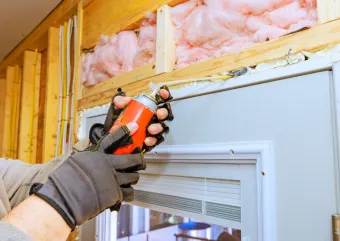
Wall assemblies play a major role in a home’s energy performance, comfort, and durability. But designing a high-performing wall involves more than increasing insulation levels. The materials and layers within an assembly need to work together to manage heat, air, water, and vapor while also being practical to design, build, and inspect.
As energy codes continue to advance, wall assembly decisions are becoming increasingly important and potentially more complex.
BuildUp MN recently brought together builders, designers, code professionals, affordable housing representatives, and other industry experts to discuss residential wall assemblies, including what drives wall assembly decisions, experiences with continuous exterior insulation (CEI), and what may influence future practices.
One thing became clear quickly: there is no single wall assembly dominating the market.
Participants discussed R-20 cavity insulation, ZIP sheathing, mineral wool, spray foam, CEI, continuous interior insulation, double-stud walls, and even some structural insulated panels (SIPs). R-20 cavity insulation remains common, while CEI is being used by some builders but has not become standard practice across the market.
Important Considerations
-
Cost and constructability
- Cost remains an important factor, but the conversation showed that it goes beyond material costs. Labor costs, contractor familiarity, and installation complexity can all influence decisions and project costs. Concerns about potential callbacks can also discourage the adoption of unfamiliar assemblies.
-
Familiarity and risk
- Designers and builders are often more comfortable using assemblies they know. Participants noted that architects may hesitate to specify unfamiliar assemblies because of concerns about installation quality and the responsibility associated with stamping a design. Higher contractor bids for unfamiliar assemblies can further discourage their adoption. Traditional assemblies that are familiar to code officials can also make plan review more straightforward.
-
Building science and durability
- Meeting a high energy target can lead to durability concerns if not done properly. Participants discussed moisture management, vapor control, air barriers, and the potential for issues such as a “vapor sandwich” when materials and control layers are not considered a complete system.
-
Compliance
- Some projects must meet multiple requirements, including energy codes, ENERGY STAR, and other program standards. Participants highlighted the challenge of selecting wall assemblies that satisfy these requirements while balancing performance, durability, and constructability.
-
Education
- The discussion also emphasized the need for greater familiarity with advanced assemblies among designers, builders, and code officials. One practical suggestion was to develop a resource featuring proven wall assemblies that industry professionals could reference when making design and construction decisions.
As Minnesota moves toward more efficient buildings, the industry will need practical guidance that makes choosing higher-performing wall assemblies easier to design, build, and review.
The discussion group helped connect perspectives from across the industry and identify where additional education and resources could have the greatest value. These conversations give BuildUp MN a clearer picture of what is happening in the field and where we can help address the gap between code requirements and real-world implementation.